A study published in Frontiers in Ecology and the Environment examined grey wolf pack stability over 33 years across five National Parks in the United States. The parks were located in Alaska, Wyoming, and Minnesota:
Many different population management methods have been used throughout American history, ranging from complete eradication campaigns in the late 19th and early 20th centuries to full federal protection under the Endangered Species Act in 1974, followed by localized de-listings and managed harvest seasons. The study examined the survival and continuity of packs based on mortality levels and the structural roles of lost pack members.
Canis lupus • Yellowstone Wolf Project
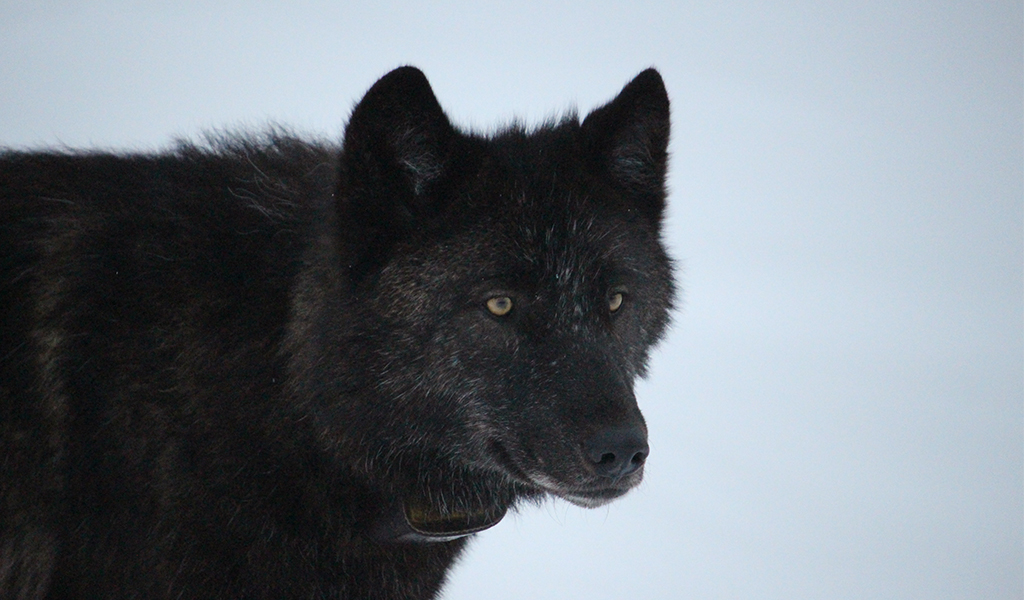
Following their historic reintroduction to Yellowstone National Park in 1995, long-term radio-collar and GPS telemetry have tracked pack genealogy, territory boundaries, mortality vectors, and pack fission/fusion events over multiple wolf generations.
Pack Size Variations Across Ecosystems
The largest average pack sizes were found in Yellowstone and Grand Teton National Parks, where pack sizes ranged from 6 to 8 members in the early spring, expanding to 10 to 12 members in the fall following summer pup rearing. Abundant ungulate prey—primarily elk (Cervus canadensis) and bison (Bison bison)—supports large communal groups capable of defending expansive territories.
The smallest packs were documented in Voyageurs National Park in northern Minnesota, with an average range of only 4 to 5 members. In the dense boreal forests and wetlands of Voyageurs, wolves rely heavily on solitary white-tailed deer and seasonal beaver, where large cooperative hunting parties offer lower energetic returns compared to open plains.
Anthropogenic vs. Natural Mortality Asymmetry
The authors found that human-caused deaths tended to have much more drastic effects than natural deaths among pack members. Human-caused mortalities are significantly more likely to involve experienced pack leaders, breeding females, or other prime, healthy members of the pack.
When breeding females were lost, the pack was very unlikely to produce pups the next spring. Most human-caused deaths were from legal hunting or illegal poaching along park boundary zones, while accidental deaths were primarily caused by high-speed vehicle collisions on trans-park highways.
Crucially, the authors emphasized that the dissolution or collapse of a pack does not necessarily imply the mortality of all its individual members. Pack dissolution and subsequent pack formation are an intrinsic, natural feature in the life history of grey wolves. Dispersing surviving wolves frequently join neighbouring packs, form new bonded pairs in vacated territories, or establish new familial lineages. Overall regional populations tend to persist even as individual packs fracture and reorganize.
Documentary & Study Research Video Feeds
Field footage, radio collar telemetry observations, and research study walkthroughs
The Mathematical Mechanics of Pack Persistence
Generalized Logistic PersistenceTo capture the non-linear dynamics discovered by Cassidy, Borg, and colleagues across the 33-year park dataset, annual pack persistence probability can be expressed via a multi-variable logistic response curve:
The coefficient for human-caused loss is empirically greater than , reflecting that human harvesting is non-selective with respect to social standing and disproportionately removes prime reproducing adults (), collapsing reproductive continuity into the following spring.
Wolf Pack Persistence & Stability Simulator
Loss of breeding female drops spring pup recruitment likelihood to near zero.
Primary Scientific References & Field Projects:
-
1.
Frontiers in Ecology and the Environment: Cassidy, K.A., Borg, B.L., et al. (2023). Human-caused mortality triggers pack dissolution and shifts in wolf social stability across US National Parks. Read Paper [PDF] ↗
-
2.
Voyageurs Wolf Project: University of Minnesota & Voyageurs National Park research initiative investigating summer ecology, predation, and pack dynamics in the Northwoods. voyageurswolfproject.org ↗
-
3.
Yellowstone Forever Wolf Project: Dedicated conservation and long-term population tracking across the Greater Yellowstone Ecosystem. yellowstone.org/wolf-project ↗
The Monthly Dispatch: Signal Over Noise.
No daily email spam. One to two digests per month exploring scientific paradoxes and discoveries.
An Attempt to Build on Dr Grimes Viability of Conspiratorial Beliefs
Mathematical modeling of conspiratorial secrecy half-lives, Poisson defectors, and Gompertzian mortality decay.
London Doctors Pioneer Treatment of Hypertension-Causing Adrenal Adenomas
Targeted ablation of aldosterone-secreting adrenal adenomas using C-11 metomidate PET-CT scans to cure primary aldosteronism.