Astrophysics & Exoplanets • Celestial Mechanics
The Discovery of Exoplanet LP 791-18d
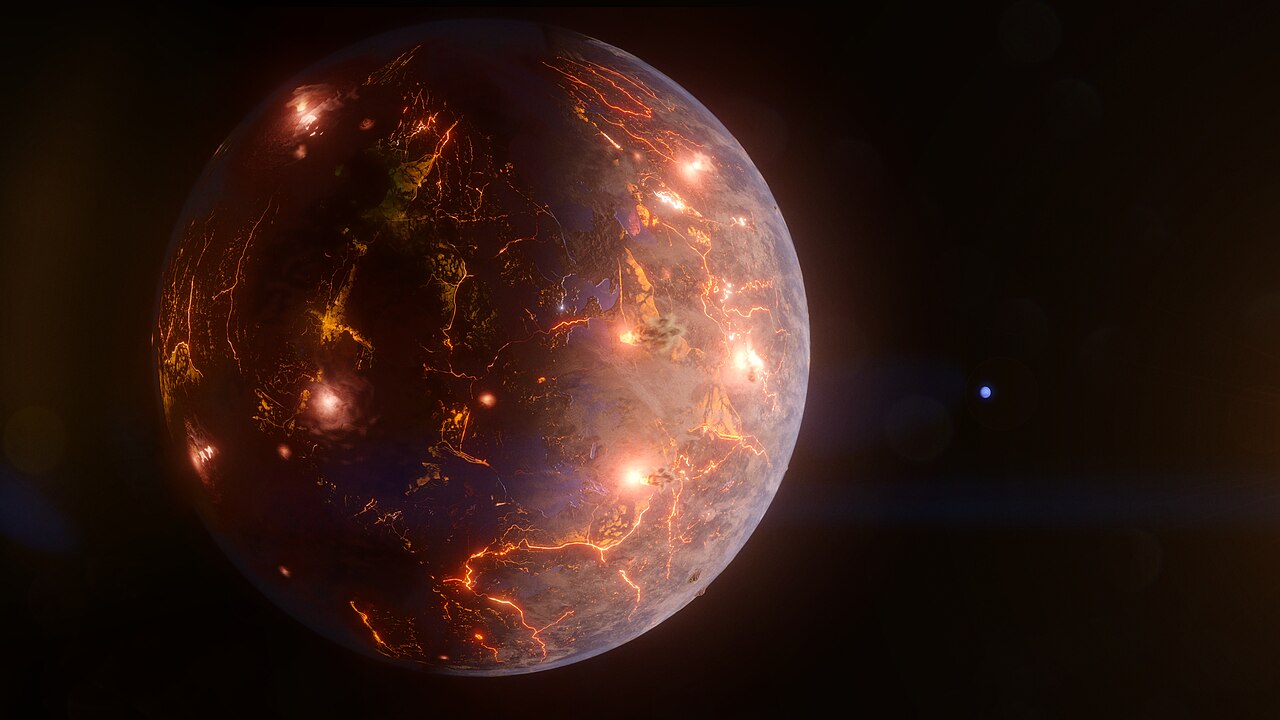
Detected via NASA’s TESS and Spitzer telescopes around a cool M6V red dwarf 86.9 light-years away, Earth-sized exoplanet LP 791-18d experiences gravitational perturbations from neighbor LP 791-18c—driving persistent orbital eccentricity, internal tidal flexing, and potentially planet-wide volcanism.
CH
Cameron Hoppe
Published June 4, 2023 • Post #18
Research Briefing Dispatch
YouTube • 16:9
Produced by Cameron Hoppe • LP 791-18d Geology & Atmosphere
Watch Directly on YouTube
↗
Original Post Links (June 4, 2023)
4 Archival Resources Included in Dispatch
Celestial Mechanics & Mantle Physics
LP 791-18 Tidal Resonance & Volcanism Explorer
Model gravitational perturbations between sub-Neptune LP 791-18c and rocky LP 791-18d, and explore how forced orbital eccentricity sustains mantle convection and terminator water condensation.
Active Tidal Volcanism
$$\dot{E}_{\text{tidal}} = \frac{21}{2}\,\frac{k_2}{Q}\,\frac{G M_\star^2 R_p^5 n}{a^6}\,e^2, \qquad P_b:P_d:P_c \approx 0.95 : 2.75 : 4.99\;\text{days}$$
$e$ (Eccentricity)
Forced Eccentricity ($e$)
Sub-Neptune LP 791-18c perturbs planet d on every close pass, preventing circularization ($e > 0$) so tidal heating scales as $e^2$.
$k_2 / Q$
Love Number & Dissipation
Controls how strongly the silicate mantle flexes and dissipates orbital mechanical energy as internal volcanic heat.
$M_c \approx 7.1 M_\oplus$
Sub-Neptune Perturber
Outer companion (~2.3–2.5 $R_\oplus$) producing detectable Transit Timing Variations (TTVs) used to constrain planet d’s mass (~0.9 $M_\oplus$).
0.015
0.000 (Dormant Crust)
0.015 Nominal
0.050 Intense Flexing
7.1 M⊕
1.0 M⊕ (Weak)
7.1 M⊕ Observed
12.0 M⊕ Strong TTV
Modeled Tidal Flux
3.4 W/m²
Relative to Io (~2.2 W/m²)
1.55x Io
Equilibrium Temp
~350 K
Day / Night Terminator
Condensation Zone Viable
References & Canonical Citations
- [1] Primary Discovery Paper: Peterson, M. S., Benneke, B., Collins, K., et al. (2023). A temperate Earth-sized planet with tidal heating transiting an M6 star. Nature, 617, 701–705. Original Link ↗ Nature Article ↗
- [2] NASA Exoplanet Catalog: LP 791-18 d System Parameters & Overview. NASA Catalog ↗
- [3] NASA Goddard Feature: NASA’s Spitzer, TESS Find Potentially Volcano-Covered Earth-Size World (May 17, 2023). NASA Release ↗
- [4] Geophysics Primer: Planetary Mantle Convection & Internal Thermal Transport. Reference ↗
Direct to Inbox
Cadence & Curation
Published 1–2 times per month. Dedicated essays and research notes curated directly by Cameron Hoppe.
The Monthly Dispatch: Signal Over Noise.
No daily email spam. One to two digests per month exploring scientific paradoxes, astrophysics, and discoveries.