Astrophysics • General Relativity & Stellar Remnants
White Dwarf LAWD 37 and Gravitational Lensing
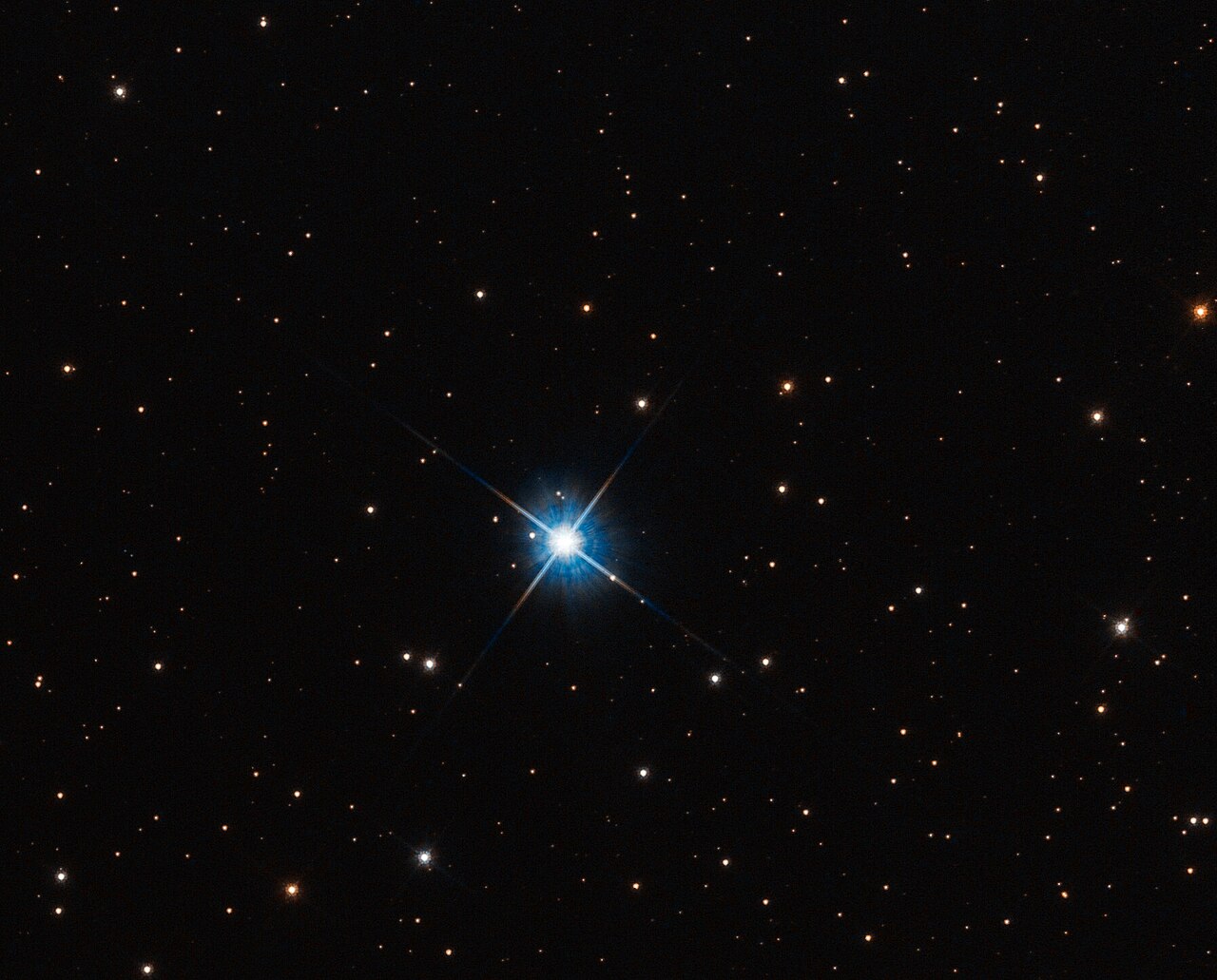
Using astrometric predictions from ESA’s Gaia mission and precision imaging from Hubble, astronomers directly measured the mass of isolated carbon-rich white dwarf LAWD 37 (0.56 ± 0.08 solar masses) via general-relativistic light deflection—the first solitary star weighed outside the Sun this way.
CH
Cameron Hoppe
Published August 1, 2023 • Post #22
Research Briefing Dispatch
YouTube • 16:9
Produced by Cameron Hoppe • Solitary White Dwarf LAWD 37 Measured by Gravitational Microlensing
Watch Directly on YouTube
↗
August 1, 2023 • Authentic Companion Deck
Show Notes — Mass of White Dwarf LAWD 37
SLIDE 1 OF 17
Discovery
General Relativity & Electron Degeneracy
Astrometric Microlensing & White Dwarf Mass-Radius Simulator
Simulate the 2019 Hubble astrometric centroid deflection loop produced by LAWD 37, and examine how increasing white dwarf mass amplifies Einstein-ring bending while shrinking stellar radius.
LAWD 37 • 0.56 M☉
$$\Theta_E = \sqrt{\frac{4 G M_L}{c^2}\left(\frac{1}{D_L} - \frac{1}{D_S}\right)}, \qquad \Delta\theta_c(u) = \frac{u}{u^2 + 2}\,\Theta_E$$
$\Theta_E$ (Einstein Radius)
Angular Einstein Ring
Characteristic lensing angle scaling as $\sqrt{M_L}$. Directly relates Hubble’s measured deflection to the isolated white dwarf’s mass.
$\Delta\theta_c(u)$
Astrometric Centroid Shift
Flux-weighted center of the major and minor lensed images traces a sky-plane deflection ellipse peaking around $u = \sqrt{2}\,\Theta_E$.
$1.456\,M_\odot$
Chandrasekhar Limit
Maximum mass supported by relativistic electron degeneracy pressure before collapse or Type Ia supernova ignition.
0.56 M☉
0.20 M☉ Low-Mass
0.56 M☉ LAWD 37
1.42 M☉ (~M_Ch)
1.15 θE
0.25 (Near-Ring)
1.41 Peak Shift
3.00 Wide Pass
Einstein Radius ($\Theta_E$)
18.4 mas
Peak Centroid Shift
6.36 mas
Degenerate Radius
0.0127 R☉
Mean Mass Density
~3.85 × 10⁵ g/cm³
References & Canonical Citations
- [1] Primary Discovery Paper: McGill, P., Anderson, J., Casertano, S., et al. (2023). First semi-empirical test of the white dwarf mass–radius relationship using a single white dwarf via astrometric microlensing. Monthly Notices of the Royal Astronomical Society. arXiv PDF ↗
- [2] Historic Lensing Foundations: Dyson, Eddington & Davidson (1920), 1919 Solar Eclipse; Khvolson (1924), Einstein Rings. 1919 Paper ↗
- [3] ESA/NASA Hubble Release: Hubble Directly Measures Mass of a Lone White Dwarf (heic2301a). ESA Hubble ↗
- [4] Companion Presentation: Hoppe, C. (August 1, 2023). Mass of White Dwarf LAWD 37 Determined By Gravitational Microlensing (18-Slide Archival PDF). Open Show Notes PDF ↗
Direct to Inbox
Cadence & Curation
Published 1–2 times per month. Dedicated essays and research notes curated directly by Cameron Hoppe.
The Monthly Dispatch: Signal Over Noise.
No daily email spam. One to two digests per month exploring scientific paradoxes, astrophysics, and discoveries.