Astrophysics & Magnetars • Quasi Wolf-Rayet Progenitors
HD 45166 B — A Star With a Powerful Magnetic Field May Be a Future Magnetar
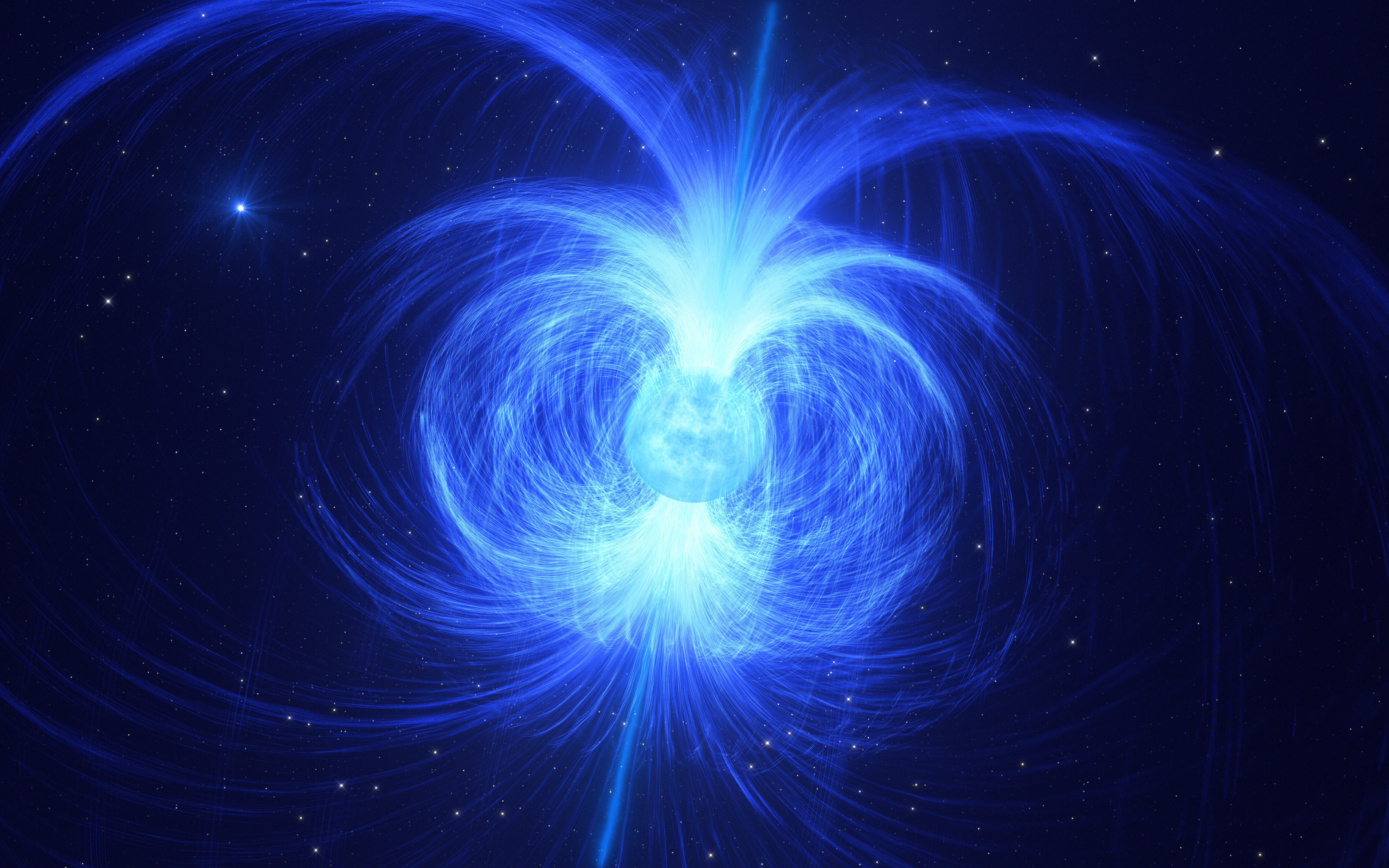
A 24-year spectroscopic study of binary star system HD 45166 uncovered a 43-kilogauss (4.3 Tesla) magnetic field on its quasi Wolf-Rayet helium star—revealing a merged subdwarf origin that points straight toward a future ~10¹⁰ Tesla magnetar remnant.
CH
Cameron Hoppe
Published August 30, 2023 • Post #28
Research Briefing Dispatch
YouTube • 16:9
Produced by Cameron Hoppe • Is This Quasi Wolf-Rayet Star a Future Magnetar?
Watch Directly on YouTube
↗
August 30, 2023 • Authentic Companion Deck
Show Notes — HD 45166 B & Future Magnetar Formation
SLIDE 1 OF 7
Overview
Stellar Magnetohydrodynamics & Zeeman Effect
Magnetar Core-Collapse & Zeeman Field Lab
Compress HD 45166 B’s magnetized helium core from 0.88 solar radii down to a 12 km neutron star—watching flux conservation amplify 43 kG past 10 billion Tesla alongside the system’s 24.4-year binary orbit.
Collapse 100% • 1.11×10¹⁰ T
$$B_{\text{rem}} = B_0 \left(\frac{R_0}{R}\right)^2 \eta_{\text{flux}}, \qquad \Delta\nu = \pm \frac{e B}{4\pi m_e c}$$
Zeeman $B_0 = 43\text{ kG}$
Optical Oxygen & He II Lines
Splitting in the qWR star’s O spectral lines plus high variability at He II 4686 Å revealed 43 kG (4.3 T)—nearly 3× stronger than a clinical MRI scanner.
Flux $B \propto R^{-2}$
Supernova Compression
As radius shrinks from ~611,000 km (0.68 V☉) down to ~12 km while conserving magnetic flux, field density concentrates ~2.6×10⁹-fold into ~1.11×10¹⁰ T.
Subdwarf Merger
Former Trinary Star Origin
Absence of standard Wolf-Rayet wind expulsion implies HD 45166 B formed when two helium-rich O-type subdwarfs merged inside an older triple system.
100%
0% (0.88 R☉)
50% (850 km)
100% (12 km)
43 kG (4.3 T)
10 kG (1.0 T)
43 kG Measured
80 kG (8.0 T)
100%
1% Stripped
50% Partial
100% Conserved
Core / Remnant Radius
12.0 km
Projected Field Density
1.11 × 10¹⁰ T
Progenitor Zeeman Shift
±60.2 GHz
End State Class
Magnetar (10⁹–10¹¹ T)
References & Canonical Citations
- [1] Primary HD 45166 Magnetic Study: Shenar, T., et al. (2023). A massive helium star with a sufficiently strong magnetic field to form a magnetar. Science, 381(6659), 761–765. Science DOI Paper ↗
- [2] Binary Spectroscopy & Orbital History: Steiner, J. E. & Oliveira, A. S. (2005); HD 45166 System Parameters (24.4-yr binary, 9.29–10.5 AU) & Zeeman diagnostics. arXiv:0804.1766 ↗
- [3] Magnetar Starquakes & O-Type Subdwarf Merger Physics: NASA Fermi Magnetar Storm observations; Napiwotzki (O-type subdwarfs); Zeeman Equation review. NASA Fermi Starquakes ↗
- [4] Companion Presentation: Hoppe, C. (August 30, 2023). The Wolf-Rayet Star of HD 45166 and Why It Might Become a Magnetar (8-Slide Archival PDF). Open Show Notes PDF ↗
Direct to Inbox
Cadence & Curation
Published 1–2 times per month. Dedicated essays and research notes curated directly by Cameron Hoppe.
The Monthly Dispatch: Signal Over Noise.
No daily email spam. One to two digests per month exploring scientific paradoxes, astrophysics, and discoveries.