Astrophysics & General Relativity • Nanohertz Gravitational Waves
Millisecond Pulsars Used to Analyze the Gravitational Wave Background
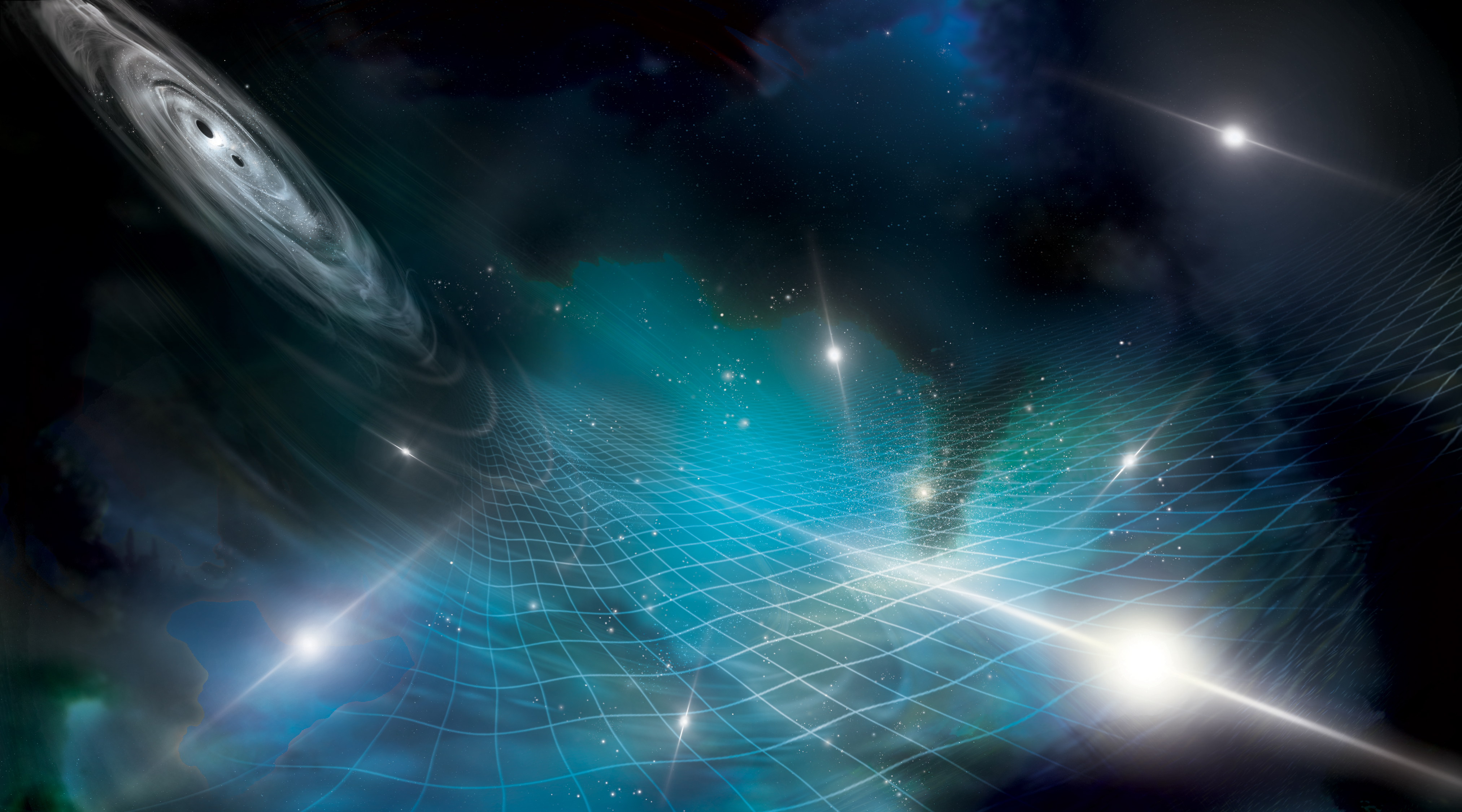
Turning the Milky Way into a galaxy-scale interferometer, 15 years of NANOGrav millisecond pulsar timing revealed ~99.7% evidence for low-frequency spacetime ripples shaped by orbiting supermassive black hole pairs and early-universe physics.
CH
Cameron Hoppe
Published August 21, 2023 • Post #27
Research Briefing Dispatch
YouTube • 16:9
Produced by Cameron Hoppe • What Millisecond Pulsars and the Gravitational Wave Background Say About the Cosmos
Watch Directly on YouTube
↗
August 21, 2023 • Authentic Companion Deck
Show Notes — Millisecond Pulsars & the Gravitational Wave Background
SLIDE 1 OF 10
Overview
General Relativity & Stochastic Background
NANOGrav Pulsar Timing Array & Hellings–Downs Lab
Explore how passing nanohertz gravitational waves synchronize or anti-correlate timing residuals across pulsar sky pairs, producing the unmistakable Hellings–Downs quadrupole signature.
θ = 45° • Γ = +0.119
$$\Gamma(\theta) = \frac{1}{2} - \frac{1}{4}x + \frac{3}{2}x\ln x, \quad x = \frac{1-\cos\theta}{2}, \quad h_c(f) \propto A\left(\frac{f}{\text{yr}^{-1}}\right)^{-2/3}$$
$\Gamma(\theta)$ (Hellings–Downs)
1983 Quadrupole Signature
Distinctive S-shaped correlation vs. angular separation θ: positive for close pairs (θ≈0°), negative around ~82°, and rising back near +0.25 at 180°.
Final Parsec (0.03–3 LY)
SMBHB Stalling Horizon
Strongest nanohertz signals come from >10⁹ M☉ pairs separated by 0.03–3 light-years at redshift z < 1 (~11B LY), supporting Final Parsec survival.
SMBHB vs Cosmic Strings
New Physics Cosmologies
NANOGrav 15-yr data also tests inflationary GWs, phase transitions, and cosmic superstrings—competing with pure SMBHB models at comparable Bayes factors.
45°
5° Aligned (+0.45)
82° Trough (-0.15)
180° Opp (+0.25)
6.0 nHz
2.0 nHz (16 yr)
10 nHz
25.0 nHz (1.3 yr)
2.4 × 10⁻¹⁵
0.5 Quiet
2.4 NG15 Ref.
3.5 Strong SMBHB
Hellings–Downs Γ(θ)
+0.119
Orbital Period Window
5.3 Years
Peak Timing Shift
±190 ns
Pair Correlation Mode
Positive In-Phase
References & Canonical Citations
- [1] NANOGrav 15-Year GWB & SMBH Binary Constraints: Agazie, G., et al. (2023). The NANOGrav 15 yr Data Set: Evidence for a Gravitational-wave Background & Constraints on Supermassive Black Hole Binaries. ApJL, 951, L8 / ApJL ace18b. ApJL SMBHB Paper ↗
- [2] Search for New Physics Cosmologies: Afzal, A., Agazie, G., et al. (2023). The NANOGrav 15 yr Data Set: Search for Signals from New Physics. ApJL (Cosmic Superstrings & Inflationary Models). ApJL New Physics ↗
- [3] Foundational 1983 Theory & Dual-SMBH Observations: Hellings, R. W. & Downs, G. S. (1983), ApJ Letters 265, L39; Koss et al. (2023), UGC 4211 (~230 pc Dual SMBH). Hellings & Downs (1983) ↗
- [4] Companion Presentation: Hoppe, C. (August 21, 2023). Millisecond Pulsars, Supermassive Black Holes, and the Gravitational Wave Background (11-Slide Archival PDF). Open Show Notes PDF ↗
Direct to Inbox
Cadence & Curation
Published 1–2 times per month. Dedicated essays and research notes curated directly by Cameron Hoppe.
The Monthly Dispatch: Signal Over Noise.
No daily email spam. One to two digests per month exploring scientific paradoxes, astrophysics, and discoveries.