Astrophysics • Marine Biology • Live Research Stream

Live Struggle Stream #1 - May 2, 2023

Live research session exploring Velella velella hydrodynamic sail mechanics and California beach strandings, Seyfert galaxy UGC 4211's dual supermassive black hole collision, and the physical limits required to ignite a Type 2 quasar.

CH

Cameron Hoppe

Published May 3, 2023 • Post #11
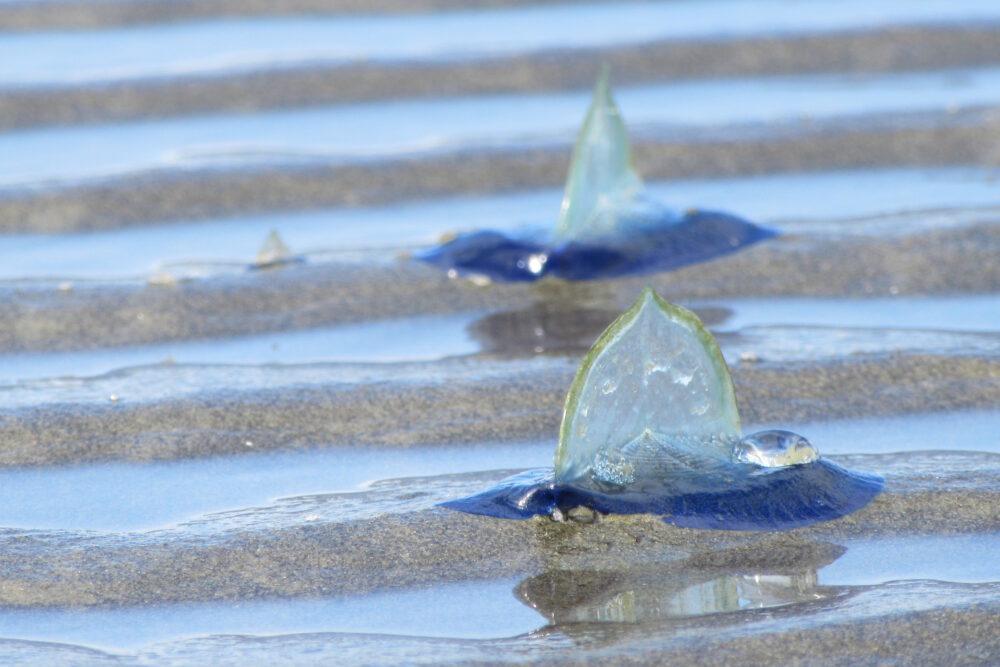
Velella velella (by-the-wind sailors) washed up on a California beach
Velella velella (by-the-wind sailors) stranded along the California shoreline. Distinct upright triangular sails catch coastal winds, driving mass beach stranding events. Photo: CaliforniaBeaches.com
Multiwavelength, multiscale images of Seyfert 2 galaxy UGC 4211 showing dual supermassive black holes
Multiwavelength, multiscale observations of UGC 4211: DECaLS (optical merger scale), VLT/MUSE AO, HST F814W, Keck NIRC2 AO (J and K' bands), and ALMA 231 GHz continuum resolving the dual active galactic nuclei at 230 pc separation. Credit: Koss et al. (ApJL)
Live Broadcast Archive
Episode #1
The Sexy Universe Live Struggle Stream Episode #1 • May 2, 2023 Watch on YouTube ↗
Hydro-Aerodynamic Oceanic Model

Velella velella (By-the-Wind Sailor) Drift & Stranding Simulator

Simulate wind vectors, asymmetric 45° hydrodynamic sail tacking, and mass stranding dynamics along the California coastline.

Pelagic Gyre Drift
Wind Vector & Speed
245° • 18 kt
WSW (Onshore Breeze)
Aerodynamic Tack Angle
±45.0°
Lift-to-Drag Vector
Colony Census
140 Sailing
0 Stranded on Shore
Sail Dimorphism
50% Left / 50% Right
NW-SE vs NE-SW Crests
PACIFIC GYRE • Offshore breeze keeps colonies cruising deep ocean waters
WIND ↑ 245°
245° (WSW)
0° (N) 90° (E) 180° (S) 270° (W)
18 knots
4 (Calm Drift) 18 (Breeze) 40 (Gale)
50% Left
0% (All Right) 50% (Mixed) 100% (All Left)
Scenarios:
Relativistic Orbital Evolution Engine

UGC 4211 Binary Supermassive Black Hole & Quasar Ignition Engine

Watch how the dual supermassive black holes spiral inward through the dense collision cloud via dynamical friction, ignite a luminous quasar, and stall once the gas is consumed.

Phase 1: Dense Cloud Dynamical Friction
Infall Accretion Rate
0.32 M☉/yr
Quasar Threshold: ≥ 0.20 M☉/yr
Nuclear Separation
230 pc
~750 Light-Years (ALMA/Keck)
Inspiral Velocity (dr/dt)
28.4 pc/Myr
Active Gas Dynamical Friction
Gas Cloud Reservoir
60.0 × 10⁷ M☉
Dense Circumnuclear Envelope
RAPID INSPIRAL • Dense gas cloud drains orbital energy via dynamical friction
Time: 0.0 Myr
Evolution Speed:
60.0 × 10⁷ M☉
5 (Starved Cloud) 60 (UGC 4211 Baseline) 100 (Hyper-Gas-Rich)
230 pc
20 pc (Stalled Hard Binary) 230 pc (Observed) 450 pc (Early Merger)
85% Opacity
10% (Diffuse) 85% (Dense Cocoon) 100% (Fully Occluded)
Astrophysical Scenarios:
The Astrophysics of Binary Inspiral & Stalling: When the two supermassive black holes travel through the dense merger cloud, dynamical friction from surrounding gas creates a gravitational drag that rapidly drains orbital energy, pulling the black holes closer together. If the accretion rate reaches ≥ 0.20 M☉/year, twin relativistic jets erupt and luminous radiation pressure blows the surrounding gas cloud away into deep space. Once the cloud is consumed and blown clear, gas dynamical friction vanishes—causing the orbital decay rate to plunge to near zero and stalling the binary at ~20–30 pc separation (the classic "Final Parsec Problem").
Authentic Broadcast Slides

May 2, 2023 Struggle Stream Show Notes

Complete 10-slide research deck covering marine hydrozoans, science birthdays, Seyfert galaxy UGC 4211, and Type 2 Quasar astrophysics.

1 / 10
PDF

May 2, 2023 Struggle Stream Show Notes (PDF)

Original presentation slide deck • 742 KB • 10 Slides

Direct to Inbox

The Monthly Dispatch: Signal Over Noise.

No daily email spam. One to two digests per month exploring scientific paradoxes, clinical breakthroughs, and celestial mechanics.

← Read Previous Post

Air Pollutants Linked to Late-Onset Depression

Medicare epidemiology demonstrates how ambient fine particulate matter, NO2, and ozone damage cerebral microvasculature.

← Read Post #10 (Mar 6, 2023)
Read Next Post →

Schizophrenia & Cannabis Use Disorder

Danish psychiatric cohort study examining sex-differentiated incidence and population attributable risk in young adults.

Read Post #12 (May 9, 2023) →