Researchers Find Link Between Schizophrenia and Cannabis Use Disorder Stronger in Young Men Than Young Women
Researchers used the Denmark National Registry to examine the association between Cannabis Use Disorder and Schizophrenia, and how it differs between men and women.
Cameron Hoppe
Published May 9, 2023 • Post #12
Early Visualization of Neural Substrates & Synaptic Architecture
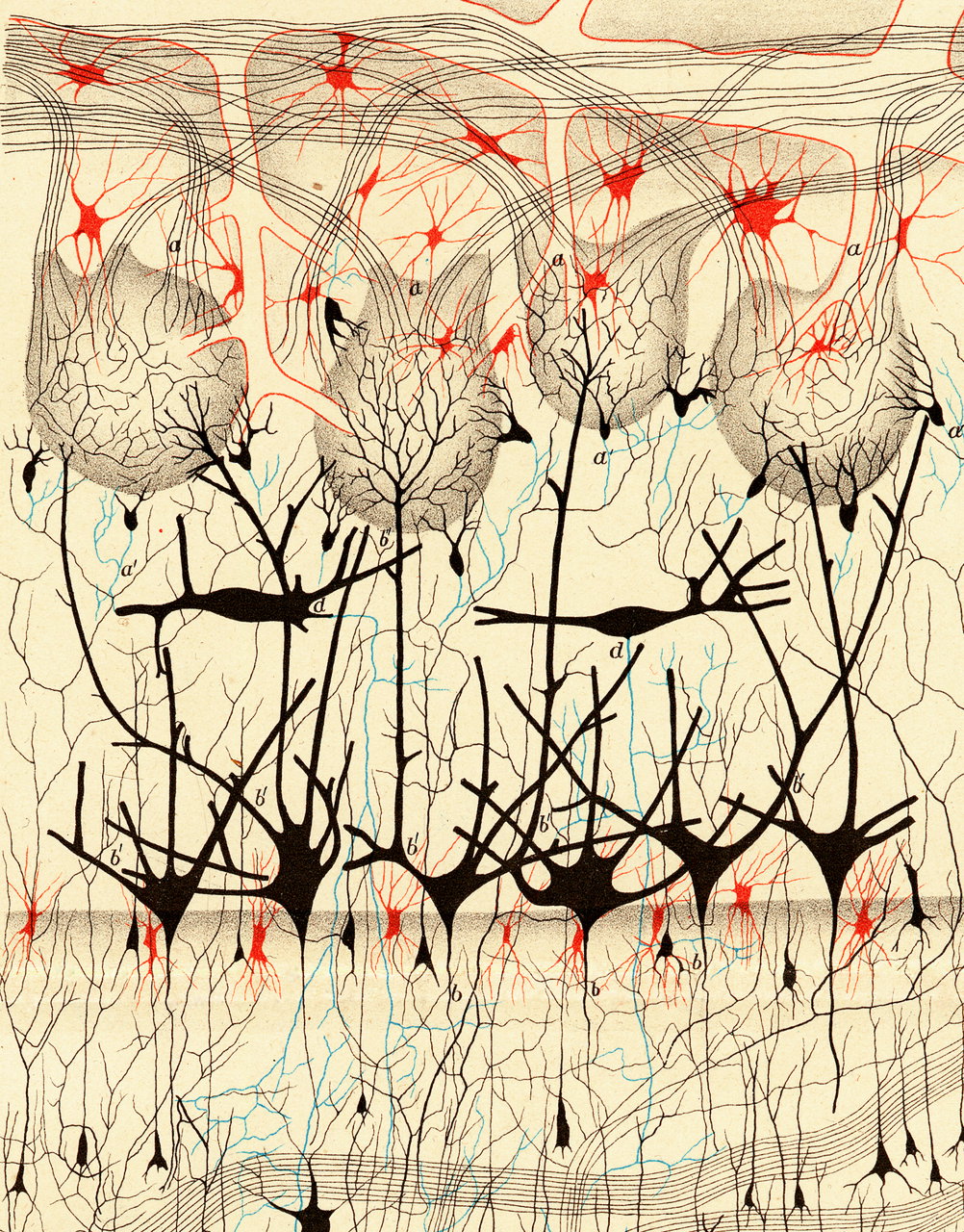
Camillo Golgi's landmark silver-nitrate chromate (“black reaction”) lithograph from Sulla fina anatomia degli organi centrali del sistema nervoso (1885), depicting projection neurons (black) with extensive dendritic arborizations intertwined with star-shaped neuroglial astrocytes (red) and nerve fibers. Golgi's method enabled Santiago Ramón y Cajal to formulate the “Neuron Doctrine”—establishing that the brain is composed of discrete individual cells communicating across contiguous synaptic clefts rather than a continuous syncytial web. These delicate cellular arborizations and synaptic interfaces undergo extensive pruning during adolescent neurodevelopment, the precise maturational window where disruption of endocannabinoid signaling is hypothesized to elevate schizophrenia vulnerability.
Researchers Examine the Link Between Cannabis Use Disorder and Schizophrenia
Population Attributable Risk Fraction (PARF) & Demographic Risk Engine
Explore the 50-year Danish registry cohort (6.9M individuals) showing how age-dependent cannabis use disorder disproportionately drives schizophrenia incidence in young men versus young women.
References & Clinical Overviews
Direct citations from the author show notes and published peer-reviewed literature.
- Link to Research Article: https://doi.org/10.1017/S0033291723000880 (Cambridge / Psychological Medicine)
- Schizophrenia Overview: https://www.nimh.nih.gov/health/topics/schizophrenia (NIMH Clinical Overview)
- Cannabis Use Disorder Overview: https://www.cdc.gov/marijuana/health-effects/addiction.html (CDC Health Effects)
If you're suffering from an addiction or mental health problem, please ask for help. Contact your healthcare provider or call the national hotline at 988 (Suicide & Crisis Lifeline) or 1-800-662-4357 (SAMHSA National Helpline).
The Monthly Dispatch: Signal Over Noise.
No daily email spam. One to two digests per month exploring scientific paradoxes, clinical studies, and discoveries.