The Red Shift of Quasar PKS 1127-145
Responding to a question about the red shift of a quasar.
Cameron Hoppe
Published May 9, 2023 • Post #13
Quasar PKS 1127-145 & Relativistic X-Ray Jet
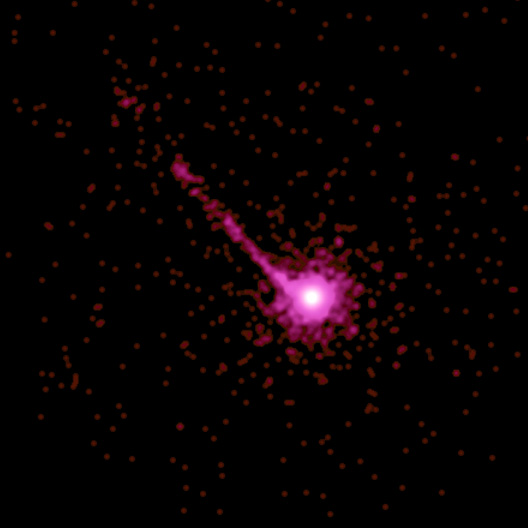
Supermassive Black Hole & Accretion Disk
The primary point-like active galactic nucleus (AGN) powered by matter accreting onto a central black hole exceeding 1 billion solar masses. Its apparent size in this image is an instrumental diffraction artifact caused by its extreme X-ray brightness.
Collimated High-Energy Plasma Beam
Ultra-relativistic plasma ejected outward along the black hole's rotational axis at near light-speed ((v > 0.99c)). X-ray surface brightness peaks here in the inner jet before gradually fading downstream.
Terminal Shock & CMB Inverse Compton
The outer terminal knot located ~28 arcseconds from the core (exceeding 1 million light-years projected distance). Relativistic electrons scatter ambient Cosmic Microwave Background (CMB) photons up into the X-ray band (the IC-CMB mechanism).
Why is there no separate visible galaxy in this X-ray photo? The intervening galaxy located 4 billion light-years from Earth is an absorption system lying directly along our line of sight in front of the quasar core, not an X-ray emitting source. Its interstellar gas clouds cast an "X-ray shadow" across the quasar's spectrum, absorbing low-energy X-rays ((0.4 - 0.6\text{ keV})). This enabled astronomers (Bechtold et al., ApJ 562:133, 2001) to measure that interstellar gas 4 billion years ago had only ~20% of modern Milky Way oxygen abundance.
The Redshift of Quasar PKS 1127-145
Cosmological Redshift & Relativistic Spectral Engine
Explore how the expansion of spacetime physically elongates photon wavelengths between emission at Quasar PKS 1127-145 and observation on Earth.
Fractional elongation of photon wavelength
Light stretches in lockstep with expanding space
Spacetime Expansion vs. Classical Motion: Unlike a standard Doppler shift (where an object travels through static space), cosmological redshift occurs because the fabric of spacetime itself expands while light travels across cosmic distances.
Because redshift equals 1.187, the fabric of the universe has physically expanded by a factor of 2.187× since emission (scale factor (a(t) \approx 0.457)). During the photons' 8.55-billion-year journey to Earth, every wavelength has been stretched by 218.7%:
Observed: 265.9 nm (Near UV)
Observed: 1,095 nm (Near-IR)
Observed: 1,435 nm (Near-IR)
References & Archival Data
Original research links, NASA Chandra X-ray imagery, cosmic distance calibration resources, and peer-reviewed literature.
- Images of the Quasar: https://chandra.harvard.edu/photo/2002/1127/ (Chandra Photo Album: PKS 1127-145)
- Red Shifts and distance: https://ned.ipac.caltech.edu/ (NASA/IPAC Extragalactic Database & Cosmology Calculator)
- NASA type 1a Supernova video: NASA Goddard Type Ia Supernovae Standard Candle Reference
Peer-Reviewed Astrophysical Publications:
-
1. Chandra Discovery of the 300 Kiloparsec X-Ray Jet
Siemiginowska, A., Bechtold, J., Aldcroft, T. L., et al. (2002). The Astrophysical Journal, 570(2), 543–556.
Reports the Chandra ACIS discovery of the collimated X-ray jet extending over 30 arcseconds (>300 kpc / 1 million light-years) from Quasar PKS 1127-145 and establishes the multi-knot structure (Knots A, B, and C).
-
2. Multi-Wavelength Jet Knots & Inverse Compton CMB Mechanism
Siemiginowska, A., Stawarz, Ł., Cheung, C. C., et al. (2007). The Astrophysical Journal, 657(1), 145–158.
Detailed Chandra, Hubble (HST), and VLA radio analysis of the jet knots. Demonstrates that X-ray emission in outer knots (such as Knot C at ~28'') is strongly enhanced by relativistic electrons up-scattering Cosmic Microwave Background (CMB) photons.
-
3. Intervening Absorber Galaxy X-Ray Shadow & Oxygen Abundance
Bechtold, J., Siemiginowska, A., Aldcroft, T. L., Elvis, M., & Dobrzycki, A. (2001). The Astrophysical Journal, 562(1), 133–144.
Detects the soft X-ray absorption shadow cast by the intervening galaxy at (z = 0.312) directly along the line of sight to the quasar core, measuring an oxygen-to-hydrogen abundance of ~20% solar 4 billion years ago.
The Monthly Dispatch: Signal Over Noise.
No daily email spam. One to two digests per month exploring scientific paradoxes, cosmic discoveries, and mathematical models.