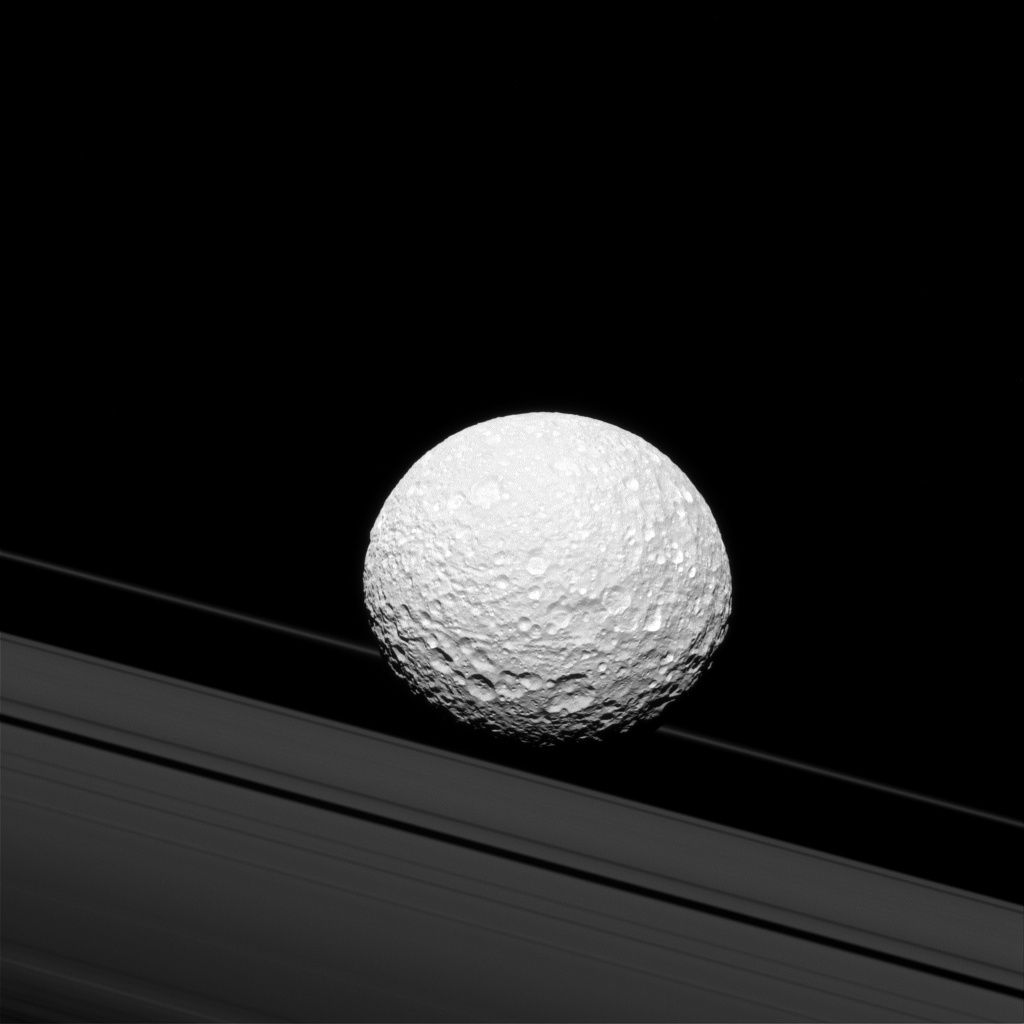
How Saturn's "Death Star Moon" Hid an Ocean in Plain Sight
Mimas has an average radius of only $198.2 ext{ km}$, roughly one-twelfth the radius of Earth's Moon, and a mean density of $1.15 ext{ g/cm}^3$, suggesting an internal composition dominated by water ice with a modest fraction of silicates. When NASA's Cassini spacecraft performed close flybys of Mimas between 2007 and 2017, its surface presented a stark contrast to known ocean worlds: no geysers, no vapor plumes, and no tectonic rifting like the "tiger stripes" of Enceladus. Instead, Mimas is saturated with ancient impact craters, dominated by the colossal Herschel Crater ($130 ext{ km}$ across, spanning one-third of the moon's entire diameter).
The breakthrough began when astronomers led by Radwan Tajeddine (Science, 2014) analyzed Cassini's optical imaging data to track Mimas's forced rotational librations—small, cyclical periodic wobbles in longitude as the moon orbits Saturn in an eccentric orbit ($e = 0.0202$). The measured libration amplitude of $44 pm 10 ext{ mrad}$ was nearly double the theoretical amplitude expected for a frozen hydrostatic moon. Subsequent geophysical modeling by Alyssa Rhoden (Icarus, 2022) and Valéry Lainey (Nature, 2024) confirmed that a non-hydrostatic core model was unphysical, leaving only one viable physical mechanism: a liquid ocean between 20 and 30 km beneath the ice shell, thermally maintained by tidal dissipation in an evolving eccentric orbit.


