Impact of High School Quality on Later Life Cognitive Ability
Investigating the 58-year Project TALENT Aging Study: how adolescent high school quality—especially teacher graduate training—permanently reshapes cognitive trajectories, verbal fluency, and dementia resilience at age 75.
Cameron Hoppe
Published May 11, 2023 • Post #15
School Children Studying Anatomy or Health, Washington, D.C.
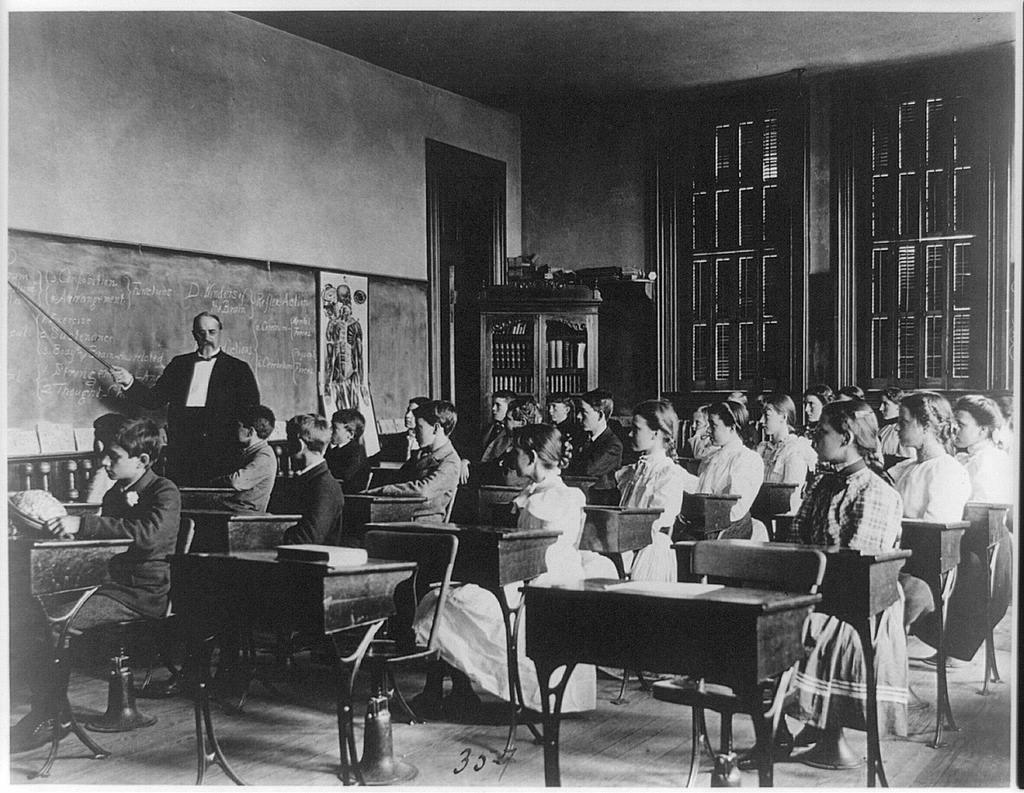
Photograph by Frances Benjamin Johnston (1864–1952) capturing Washington, D.C. public school pupils engaged in scientific and anatomical study (c. 1899, LCCN 2001699123). Early institutional environment, curriculum rigor, and instructional caliber establish enduring neural scaffolding for cognitive reserve, directly echoing findings from the 58-year Project TALENT cohort follow-up.
High School Quality and Late Life Cognitive Ability
Project TALENT 58-Year Cognitive Reserve Simulator
Model longitudinal cognitive performance trajectories ($z$-score from age 16 to 85) based on the 1960 Project TALENT cohort follow-up (Šeblová et al., 2023). Test how faculty graduate degrees and school resources buffer late-life cognitive decline and postpone clinical dementia onset.
Load authentic institutional profiles surveyed by Project TALENT across 1,353 U.S. high schools in 1960.
Strongest independent predictor of late-life language ability and verbal fluency (p < 0.001).
Total annual instructional exposure and curricular depth in 1960.
1960 Project TALENT cognitive test composite at high school entry.
In Yaakov Stern's cognitive reserve paradigm, individuals with greater neural compensation capacity tolerate higher burdens of neuropathology (such as amyloid-$\beta$ plaques and neurofibrillary tau tangles) before manifesting clinical cognitive impairment. The longitudinal trajectory of cognitive function $C(t)$ over lifespan $t$ can be expressed as:
The landmark contribution of Šeblová et al. (2023) is demonstrating that high school quality ($\beta_{\text{quality}} \approx 0.09 - 0.11\text{ SD}$) operates independently of adolescent ability ($A_{16}$) and post-secondary educational attainment ($E_{\text{years}}$). In adolescence, human prefrontal cortex undergoes critical waves of synaptic pruning and myelination. High-caliber instructors with advanced subject-matter training foster complex conceptual abstraction, building rich semantic networks that provide redundant neural circuits across six decades of life.
References & Archival Data
Original research links and primary peer-reviewed literature.
- Link to Original Research Article: https://doi.org/10.1002/dad2.12401 (Alzheimer's & Dementia: DADM)
- Šeblová, D., Fischer, M., Eng, C. W., et al. (2023). "High school quality is associated with cognition 58 years later." Alzheimer's & Dementia: Diagnosis, Assessment & Disease Monitoring, 15(1), e12401. doi:10.1002/dad2.12401
- Flanagan, J. C., et al. (1962). Design for a Study of American Youth: The Project TALENT Data Bank. Houghton Mifflin, Boston.
- Stern, Y. (2002). "What is cognitive reserve? Theory and research application of the reserve concept." Journal of the International Neuropsychological Society, 8(3), 448–460. doi:10.1017/s1355617702813248
- Manly, J. J., et al. (2022). "Estimating the prevalence of dementia and mild cognitive impairment in the US: The Project TALENT Aging Study." JAMA Neurology, 79(12), 1242–1249. doi:10.1001/jamaneurol.2022.3533
The Monthly Dispatch: Signal Over Noise.
No daily email spam. One to two digests per month exploring scientific paradoxes, longitudinal studies, and discoveries.