Earth Systems & Behavioral Ecology • Parasitic Neuro-Manipulation
The Zombie Ants of Bidstrup Forest
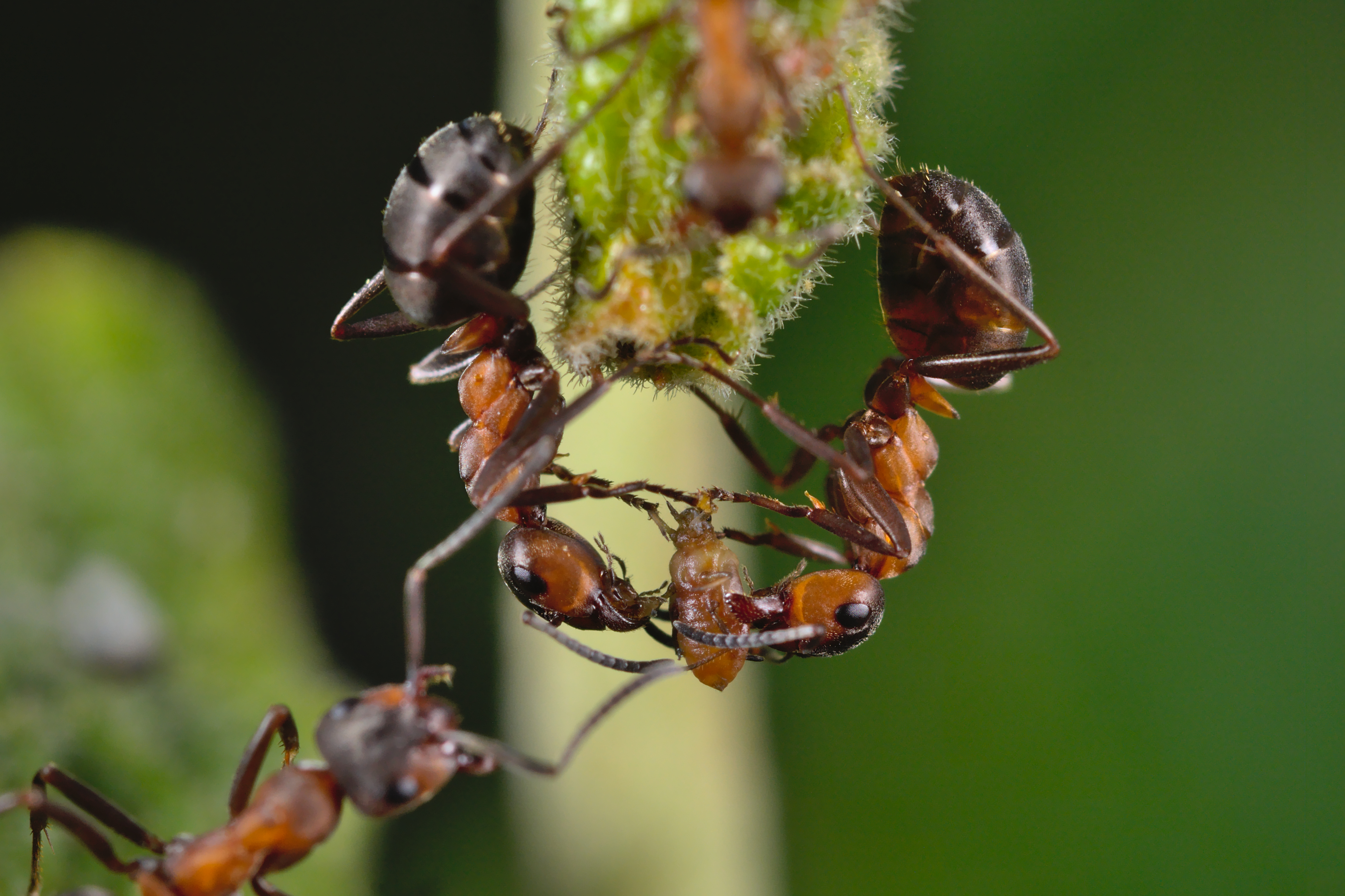
How a single microscopic liver fluke (Dicrocoelium dendriticum) encysted inside the nervous system of Danish wood ants hijacks ambient temperature and humidity like an on/off switch—driving ants up grass blades at dawn and dusk, only to release them in the midday heat.
CH
Cameron Hoppe
Published October 5, 2023 • Post #30
Research Briefing Dispatch
YouTube • 16:9
Produced by Cameron Hoppe • What Environmental Factors Trigger the Zombie Behavior of Fluke-Infested European Red Wood Ants?
Watch Directly on YouTube
↗
Proposed Molecular Signaling Cascade
Original Dispatch Diagram

October 5, 2023 • Authentic Companion Deck
Show Notes — The Zombie Ants of Bidstrup Forest
SLIDE 1 OF 6
Overview
Behavioral Parasitology & Microclimate Control
Temperature “Zombie Switch” & Fluke Lifecycle Lab
Explore how cooling air and humidity lock an infested Formica polyctena ant onto grass tips at dawn and dusk—and watch warm midday temperatures disengage mandibular tetany so it drops back to safety.
13.5°C • TETANY LOCKED
$$P_{\text{tetany}}(T, \text{RH}) = \frac{1}{1 + \exp\!\left(\frac{T - T_{\text{crit}}(\text{RH})}{k_T}\right)}, \qquad \overline{N}_{\text{switches}} \approx 0.45 + 0.105\,\Delta T_{\text{daily}}$$
1 Brain Cyst + Abdomen
Targeted Neural Encystment
Metacercariae multiply inside the ant’s gaster (97% dissection positivity) while one fluke migrates via thorax tubules to encyst against the brain.
Thermal On/Off Switch
Reversible Mandibular Tetany
Unlike fatal Cordyceps fungi, Dicrocoelium switches behavior on in cool dawn/evening air and off during hot midday, keeping its ant host alive between grazers.
Daily ΔT (0.7 → 3.4)
Bidstrup Field Regression
Tracking 172 numbered wood ants showed wider daily max–min temperature swings drove significantly more transitions (up to 3.4 behavioral switches/day).
13.5 °C
6°C Frost/Lock
18°C Switch Point
30°C Active Free
15 °C
3°C Flat/Steady
15°C Autumn
25°C High Swing
78%
40% Dry Sun
78% Bidstrup Avg
95% Heavy Dew
Host Behavior State
MANDIBLES LOCKED
Tetany Attach Prob.
92%
Mean Switches / Day
2.03 / day
Critical Switch Point
19.4 °C
References & Canonical Citations
- [1] Primary Bidstrup Forest Field Study: Gasque, S. N. & Fredensborg, B. L. (2023). Expression of parasite-induced zombie behavior is temperature dependent in Dicrocoelium dendriticum-infected Formica polyctena ants. Behavioral Ecology, 34(6), 960–968. Behavioral Ecology DOI ↗
- [2] Brain Cyst Micro-CT Anatomy: Martín-Vega, D., et al. (2018). 3D micro-CT reconstruction of Dicrocoelium dendriticum metacercariae encysted inside ant brains. PMC Micro-CT Imaging ↗
- [3] Shared Molecular Pathway & Fungal Comparison: Protein tyrosine phosphatase / TakeOut manipulation (Scientific Reports 2018); Pandora formicae wood ant zombification. Nature Sci Reports ↗
- [4] Companion Presentation: Hoppe, C. (October 5, 2023). The Zombie Ants of Bidstrup Forest (7-Slide Archival PDF). Open Show Notes PDF ↗
Direct to Inbox
Cadence & Curation
Published 1–2 times per month. Dedicated essays and research notes curated directly by Cameron Hoppe.
The Monthly Dispatch: Signal Over Noise.
No daily email spam. One to two digests per month exploring scientific paradoxes, astrophysics, and discoveries.